
How Vienna Sex Bars Handle Guests Who Drank Too Much
Alcohol is the engine of a sex bar and also its most predictable problem. The house sells drinks, the evening runs on them, and somewhere in every busy night there is a guest who has had more than the room can accommodate. What happens next is not improvised. Vienna venues have handled this situation thousands of times, they have a sequence they follow, and understanding that sequence tells you a great deal about how a well-run house actually operates.
The staff notice long before you do
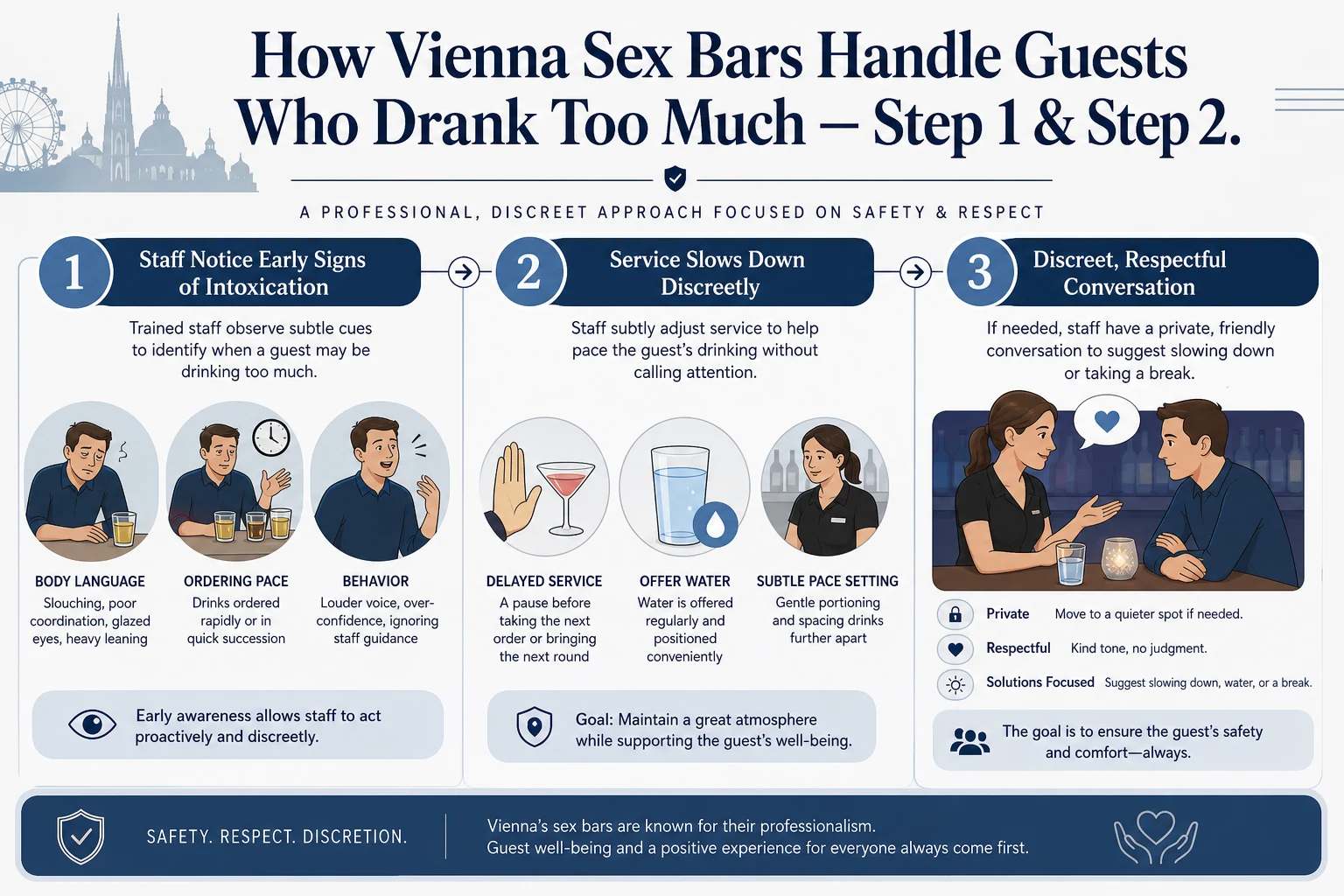
Bartenders track the room continuously, and intoxication is the thing they track most closely. They see the pace of your ordering, the volume of your voice and the way you stand when you go to the restroom, and they compare it with what you looked like an hour earlier. By the time a guest thinks he is hiding it well, the staff have usually been watching for twenty minutes.
This is part of a wider habit of reading guests quickly and quietly, the same professional attention described in what body language means inside a Vienna sex club. Nobody is being judged morally. They are assessing whether the evening is still going to be pleasant for everybody else in the room.
Step one: the drink slows down
The first intervention is almost invisible. Service simply becomes less eager. Nobody suggests another round, the next one takes longer to arrive, water appears without being ordered, and the bartender’s attention drifts elsewhere. Most guests read the signal without registering it consciously and slow down on their own, which is exactly the outcome the house wants.
It is also a commercial decision, and an interesting one. A house could keep selling, but a visibly drunk guest drives away the quieter customers who spend more over an evening. The economics of that are related to the reasoning behind why drink menus differ between premium and basic bars: more expensive rooms have less interest in volume and more interest in atmosphere.
Step two: someone says it out loud
If the quiet version does not work, a staff member says something. In a good house it is done discreetly, at your table rather than across the room, and it is framed as a suggestion: a glass of water, some air, perhaps a break from the bar. Arguing with this is the single worst move available, because it converts a private conversation into a public one and removes every remaining option from the person talking to you.
Guests who accept it gracefully almost always stay. That is worth repeating, because most people assume the opposite: agreeing to slow down is usually the thing that keeps you in the room. Resisting is what escalates, and refusal is high on every list of behaviours to avoid in a sex bar.
Step three: the exit, managed
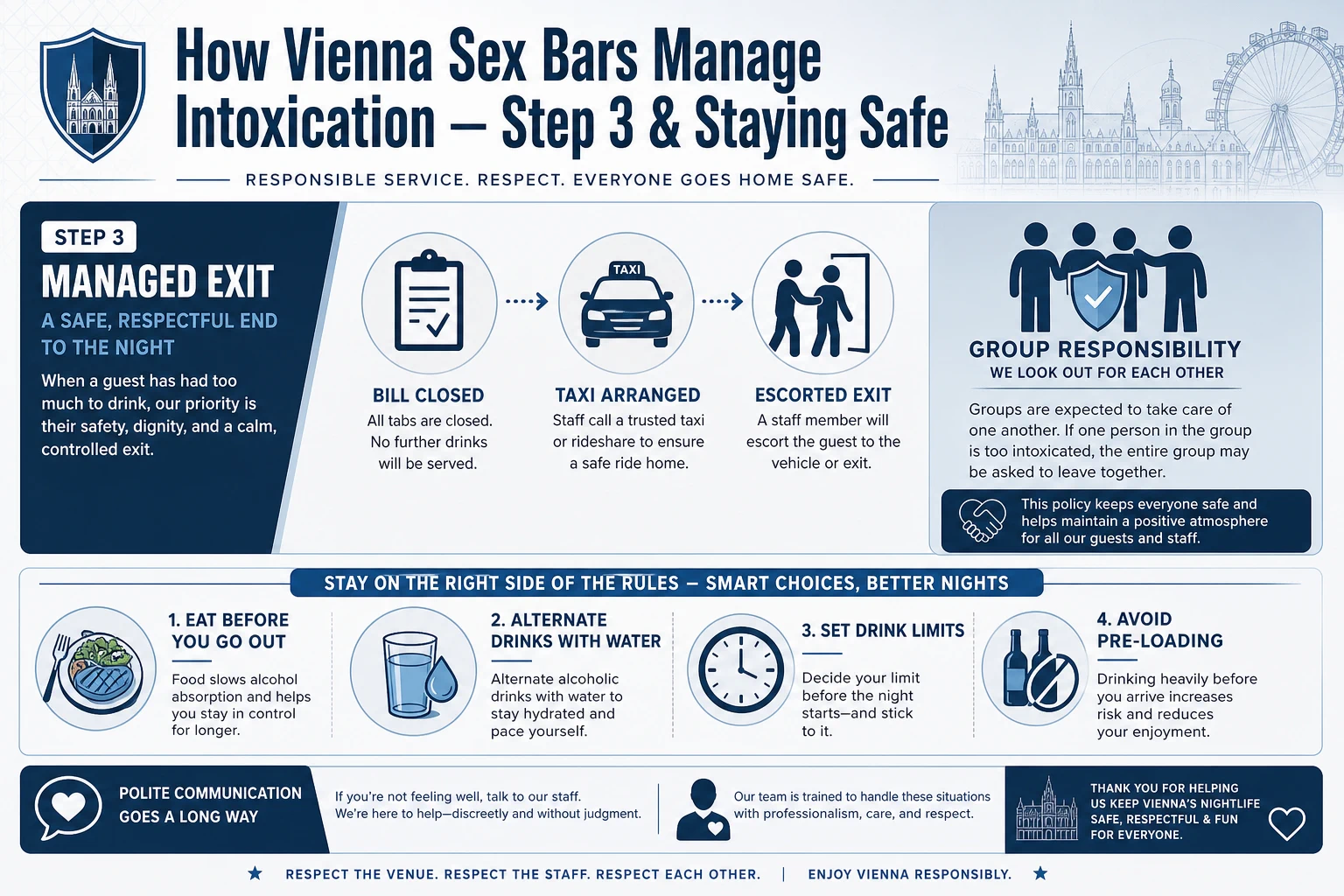
When a guest cannot be settled, he leaves. Licensed houses do this carefully rather than dramatically: the bill is closed, a taxi is called, a coat is found, and someone walks with him to the door. The care is not sentimentality. A venue that puts an incapable guest onto the street alone has a real problem if something happens to him afterwards, and every experienced manager knows it.
Groups are asked to take responsibility for their own member, which is usually effective and occasionally reveals that the group has no intention of doing so. That is the moment the whole table is invited to leave, and it is one of the practical reasons behind the list of reasons you might be denied entry in the first place: the door is where most of this is prevented.
Consent does not survive the bottle
This is the part that matters most and gets discussed least. Private arrangements require a guest capable of agreeing to them, and companions in serious houses decline when that is not the case. A refusal at this point is not a rejection of you as a person and it is not the house protecting its takings. It is the only defensible answer available to her.
The same principle runs in the other direction: a visibly intoxicated companion cannot consent either, and a house that ignores this is telling you what it is. Knowing how to accept a no without turning it into a scene is a basic competence here, covered in how to say no politely, and how to hear it, and the wider standards of the licensed sector are published by the city on the City of Vienna’s information pages for the sector.
How to stay on the right side of all this
Three habits cover nearly every case. Eat before you go, because an empty stomach and a two-hour evening is the most common route to being managed out of a bar. Alternate with water, which staff notice approvingly and which costs nothing. And set a round limit on arrival, since decisions made at the start of the night are the only ones made soberly.
Pre-loading elsewhere is the classic error, especially for groups, because you arrive at the door already at the level the house would have steered you away from. The small preparations in five tips to boost your mood before entering are a better use of the hour before than another two drinks in a different bar.
The short version
Vienna sex bars handle heavy drinking in three escalating steps: service quietly slows, then someone speaks to you discreetly, then you are helped out with a closed bill and a taxi. Accepting the first or second step almost always means staying; arguing with it is what produces the third. Groups are asked to manage their own, and a group that will not is asked to leave together.
Behind all of it sits one rule with no flexibility: private arrangements need a guest who can actually agree to them, in both directions. Eat first, drink water alongside, decide your limit before you walk in, and treat a bartender’s suggestion as the favour it usually is.


You May Also Like

Beverly Hills Club has a New Bitcoin Machine

Why sex bars can be a better choice than small sex studios